The Ultimate Guide to Commercial Tire Truck Kits: Getting the Most Out of Your Fleet’s Safety and ROI
In the high-stakes world of commercial trucking, the difference between a profitable delivery and a terrible emergency on the side of the road can be as little as a few pounds per square inch (PSI). Tires are still the most important part of every heavy-duty truck, even though current engines and logistical software are getting more and more advanced.
The tires are the only part of a 40-ton vehicle that touches the ground. But even though they are important, tire maintenance is often done after the fact instead of before it happens. Quick Pressure’s “Commercial Tire Truck Kits” are a step toward a more efficient, visual, and dependable way for fleet managers and owner-operators to manage their tires.
The High Price of Low Tire Pressure in Business Fleets
Under-inflation is the “silent killer” of tires used in business. Studies by the Department of Transportation (DOT) show that about one-third of the trucks on the road have at least one tire that is considerably under-inflated. For a passenger automobile, this could involve going to the gas station. For a commercial truck, it could entail a complete tire failure or an accident involving several vehicles.
-
The Factor of Fuel Efficiency
Field testing on trucking fleets have indicated that under-inflation of 20–30 PSI, which is prevalent in the sector, can make fuel use go up by as much as 8% to 10%. In an industry where fuel is generally the biggest cost, a 10% rise in costs can be quite bad for a company’s bottom line. When tires are properly inflated, they roll more easily, which makes the engine function better.
-
Quick wear on the tread and early replacement
Buying commercial tires is a big investment. If a tire is only 10 PSI under-inflated, it can lose 37% of its tread life. This happens because the tire’s footprint varies, which causes the pressure to be uneven and too much heat to build up. Fleets have to replace rubber months before the end of the tire’s life instead of getting the full life out of it.
-
The “25% Rule” Is Dangerous
Safety experts say that a 25% loss in tire pressure is the “Danger Zone.” At this point, the tire starts to get a lot hotter—sometimes 40% to 50% hotter than it should be. This heat makes the tire’s internal structure weaker, which causes the tread to separate and the dreaded “blowout.”
Why Visual Monitoring Is Better Than the Dashboard
Most new trucks have a Tire Pressure Monitoring System (TPMS) that runs on electronics. Quick Pressure, on the other hand, says that only using a dashboard light is a “late-stage” approach.
When a dashboard light comes on, the tire is usually already broken or very low on air. Also, electronic sensors can break down in hostile settings because of battery failure, signal interference, and sensor damage.
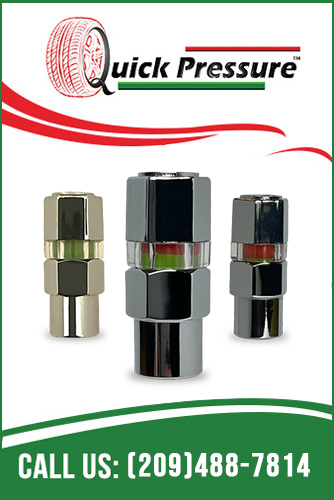
Quick Pressure Commercial Tire Truck Kits offer a mechanical and visual option. These kits come with valve caps that have been precisely calibrated and have a green/red indicator. A driver or fleet technician can do a full walk-around check in a matter of seconds. If the cap turns red, the pressure has fallen by at least 10%. This lets the driver know that anything is wrong long before they enter the “Danger Zone.”
Deep Dive: What’s in a Quick Pressure Commercial Kit?
Quick Pressure doesn’t only sell a cap that fits everyone. Their commercial kits are made to handle the tough conditions of heavy-duty transit.
Calibration with precision
Quick Pressure caps are set to work with certain PSI levels, unlike regular monitors. There is a kit for every pressure level, whether your fleet runs at 70 PSI or 130 PSI. They also have custom-made options that go up to 165 PSI for certain industrial tools.
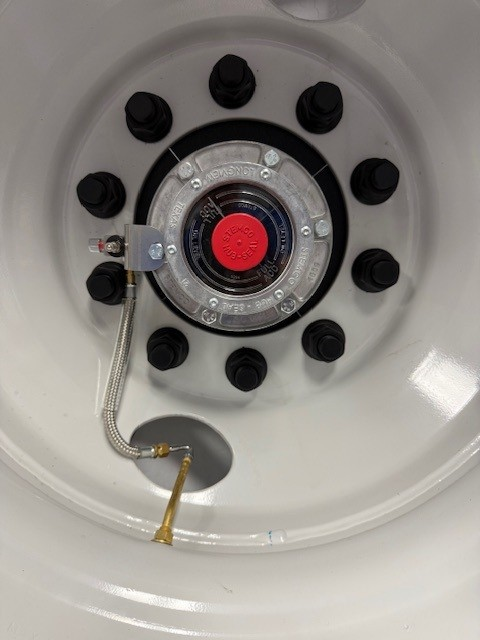
The Hardware: Hub Extensions and Brackets
Traditional valve caps don’t work well on commercial trucks, especially those with two wheels. It’s not always easy to get to the valve stem on the inner tire. Quick Pressure fixes this with:
These stainless steel brackets for commercial hubs attach directly to the wheel hub.
Stainless Steel Flexible Extensions: These braided lines are very strong and move the monitoring point from the inside tire to the outer hub, making it easy to check.
Built to Last: Durable American-Made Quality
The business world is tough. Cheap plastic sensors can break down when they come into contact with road salt, severe temperatures, and debris. Quick Pressure items are:
- Made and tested in the USA 100% of the time.
- DOT Certified: Meeting and going beyond the standards set by the NHTSA (49 CFR Parts 571 and 585).
- No batteries needed: mechanical pressure sensors that won’t stop working on a lengthy trip.
Best Practices for Fleets When It Comes to Installation and Maintenance
It’s easy to install a Quick Pressure kit, but for business use, following a specified set of steps makes sure that the readings are as accurate as possible.
- Cold Tire Calibration: Before you drive, always check and set the pressure in your tires when they are “cold” (not driven for at least three hours). As tires get hotter while driving, the pressure naturally goes higher.
- Clean the Valve Stem: Before putting on the monitor cap, make sure the threads are clean and dry.
- The “Soapy Water” Test: Quick Pressure suggests doing the “Soapy Water” Test after installation. This means putting a little bit of soapy water on the base of the cap to make sure there are no air leaks.
- Rotation Priming: When you first put on a fresh cap, it can indicate a “half-red/half-green” condition. Driving the car for about ten miles lets the centrifugal force and internal pressure “prime” the monitor so that it can give a stable, accurate measurement.
Quick Pressure Kits: What They Can Do for You
The first cost of Commercial Tire Truck Kits can pay for itself in as short as six months for a fleet of 50 trucks by:
Saving time on manual pressure checks with a gauge.
Fuel Savings: Keeping the PSI at the right level all the time.
Insurance Benefits: Many business insurance companies like fleets that use secondary safety monitoring systems, which could cut premiums.
Avoided Downtime: Stopping just one flat tire on the side of the road can save you thousands of dollars in towing fees, late delivery fees, and emergency repair charges.
In conclusion
In a business where “uptime” is the most important measure of performance, you can’t leave tire maintenance to chance. The Commercial Tire Truck Kits from Quick Pressure are a strong, easy, and very useful way to keep an eye on the health of a fleet’s most important asset.
These kits give drivers a visual “at-a-glance” status, which gives them control over their own safety and helps fleet managers safeguard their bottom line. As the roads get busier and the demands on logistics expand, having a reliable, American-made tire monitoring system will no longer be a luxury; it will be a must-have for businesses.
Visit the official Quick Pressure Shop for additional information on how to choose the proper PSI range for your fleet.
Get In Touch
Reach out to our team for product questions, support, or general inquiries. We’re here to help.